Ultra-luxury properties in the U.S. take an average of 319 days to sell; the 54% that remain on market longer than 180 days sell for nearly 20% below their original asking price. That data point, drawn from Concierge Auctions' 2025 Luxury Homes Index, describes the direct financial cost of a poorly timed, overpriced, or under-marketed listing. It also explains why the use of AI in real estate listings has become one of the most consequential variables in a high-value home sale.
AI is now embedded in how listings are written, photographed, staged, distributed, and priced. For sellers in the Catalina Foothills, Oro Valley, and surrounding luxury communities, some of these tools work squarely in your favor. Others carry a risk that most agents do not explain clearly: algorithmic pricing models with error rates of 10% to 20% or higher on properties above $2 million. Knowing when to deploy AI and when to override it separates a property that sells at market peak from one that lingers and discounts.
The table below maps each AI-powered listing application with its documented impact on days on market and sale price.
| AI-Enhanced Listing Tools and Their Impact on Sale Outcomes (2025–2026) | ||||
|---|---|---|---|---|
| Listing Enhancement | What AI Does | Impact on Days on Market | Impact on Sale Price | Source |
| Professional photography + AI editing | HDR processing, sky replacement, day-to-dusk conversion | Sells 32% faster: 89 days vs. 123 days | $3,400–$11,200 more vs. standard photos | Redfin; Wall Street Journal |
| AI-enhanced virtual staging | Digitally furnishes empty rooms from listing photos | 49% of agents report reduced DOM | 29% of agents report a 1–10% sale price increase | NAR 2025 Profile of Home Staging |
| 3D interactive tours (e.g., Matterport) | AI-powered immersive walkthroughs with anytime access | DOM dropped from 30 to 21 days (–30%) | Sale-to-list ratio: 93% → 97% | Matterport / Keller Williams case study |
| Drone and aerial photography | AI-optimized aerial capture and automated editing workflows | Listings with drone footage sell 68% faster, based on some industry analyses | Documented average sale price improvement | Roomagen, 2026 |
| AI listing description tools | NLP-generated, keyword-optimized listing copy | Faster time-to-publish and greater search visibility | 68% of agents report increased inquiries | Realtor Property Resource (RPR) Survey |
| Professional photos on $400K–$500K listings | Quality visual presentation that strengthens buyers’ perception of value | Faster showing schedule vs. standard media | Average of $11,200 more than comparable listings | Wall Street Journal |
How AI-Enhanced Marketing Changes What Buyers See First
Every listing now competes for attention before a single showing is scheduled. Buyers evaluate properties online, and according to the National Association of Realtors, 97% use the internet during their home search. The media quality a listing presents determines whether it makes a buyer's shortlist or disappears from the feed entirely.
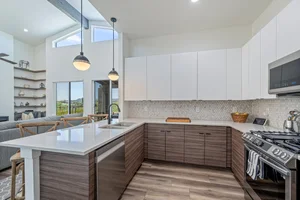
Professional photography remains the foundation. Redfin's analysis of listing data shows that homes with professional photos sell 32% faster than homes with standard images, averaging 89 days on market versus 123 days. Research compiled by imgix and the Wall Street Journal documents that listings with high-quality photography receive 61% more online views and sell for $3,400 to $11,200 more than comparable properties with lower-quality images. For homes priced between $400,000 and $500,000, the Wall Street Journal study reported an average sale price advantage of $11,200 specifically.
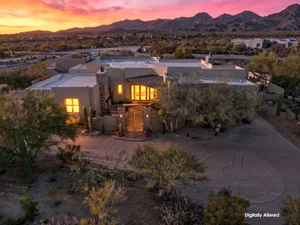
AI has accelerated the post-production workflow substantially. Tools that process listing photos now handle sky replacement, HDR blending, and day-to-dusk conversions in seconds rather than days, reducing time-to-market without sacrificing quality. For luxury listings, this timing matters: the first week a listing is live typically generates the highest buyer interest, and a media delay compresses that window.
Drone and aerial footage extends what buyers can evaluate before visiting in person. According to Roomagen's 2026 analysis, listings with aerial photography sell up to 68% faster than those without. For properties in communities like the Catalina Foothills, where lot size, mountain views, and outdoor living spaces drive much of the value, aerial footage communicates scale and setting that no interior photo can replicate.
3D Tours: When AI-Powered Walkthroughs Move the Numbers
The Matterport case study from Real Estate by Design, a Keller Williams team in San Antonio, offers one of the most directly documented outcomes for AI-powered 3D tour technology. After integrating Matterport walkthroughs into their standard listing process, their average days on market dropped from 30 to 21 days, a 30% reduction, and their sale-to-list price ratio rose from 93% to 97% within six months. A portion of their listings sold sight-unseen.
On a $750,000 Tucson home, the difference between a 93% and 97% sale-to-list ratio is $30,000 in additional proceeds. That is a direct seller benefit from a listing tool that qualifies buyers before they walk through the door. Professional photography, drone footage, and 3D tour technology are standard components of the Oliver Selling Solution, Oliver Realty's proprietary seller representation process. It pairs AI-powered marketing tools with the pricing strategy and negotiation expertise that no algorithm delivers on its own.
Where AI Pricing Falls Short for Luxury Sellers
Automated Valuation Models, the pricing algorithms behind tools like Zillow's Zestimate, Redfin Estimate, and dozens of lender-facing platforms, perform acceptably on standard residential properties with abundant comparable sales. For high-value and architecturally distinctive properties, the error rates become financially significant.
The table below shows AVM accuracy by price tier, drawing from the Own Luxury Homes AVM Accuracy Index (May 2026), Zillow's published accuracy disclosures, and PwC/ULI Emerging Trends in Real Estate 2026. The dollar exposure column applies the error rate range to the midpoint of each tier.
| AVM Accuracy by Property Price Tier and Dollar Exposure (2026) | ||||
|---|---|---|---|---|
| Price Tier | Typical AVM Error Rate | Dollar Exposure at Midpoint | Comparable Sale Density | Practical Implication for Sellers |
| $500K–$1M | 3–6% | $22K–$60K | High | Verify with recent comps before pricing |
| $1M–$2M | 5–8% | $62K–$160K | Moderate | Specialist CMA required before listing |
| $2M–$4M | 7–12% | $210K–$480K | Low | Licensed appraiser strongly recommended |
| $4M–$7M | 10–18% | $700K–$1.26M | Very Low | AVM is directional only, not actionable for pricing |
| $7M+ | 15–25%+ | $1.75M+ | Minimal | Appraiser with luxury market specialty required |
The error rates compound further for off-market properties. Zillow's own published accuracy data shows a median error rate of 6.9% on off-market homes, compared to 2.4% on active listings. On a $681,000 home, a 6.9% error represents a pricing gap of approximately $47,000. On a $1.5 million property with a 6% error, the gap is $90,000. On a $3 million property with a conservative 10% error, the exposure reaches $300,000.
What Accurate Pricing Actually Produces
Oliver Realty reports a sale-to-list ratio of 98.5% across its seller portfolio, compared to a Tucson market average closer to 95%. On a $681,000 home, that 3.49-point difference is approximately $23,767 in additional proceeds. No AVM produces that result. It comes from MLS-informed pricing strategy, current comparable analysis, and the negotiation expertise embedded in the Oliver Selling Solution.
AI vs. Human Expertise: Where Each One Belongs in a Luxury Listing
The question is not whether to use AI in a real estate listing. The question is which applications deliver seller value and which require human judgment to manage correctly. The table below maps both.
| AI Applications in Luxury Listings: Where It Helps vs. Where Human Expertise Is Required | |||
|---|---|---|---|
| Listing Task | What AI Does | Documented Outcome | Human Override Required? |
| Listing description copy | Generates keyword-optimized descriptions quickly | 68% of agents use AI for marketing copy; faster time-to-publish | Yes: luxury narrative, privacy-first tone, and property story require human direction |
| Virtual staging | Digitally furnishes rooms from listing photos | 83% of buyer agents say staging helps buyers visualize the property (NAR 2025); 8–12% higher sale prices in the luxury segment | For high-value listings: physical staging preferred; AI staging used for selective rooms |
| Property valuation (AVM) | Estimates value from public sales data and comps | ~3% error on standard homes; 10–20%+ error on properties above $2M | Always: luxury pricing requires human CMA, negotiation context, and market timing |
| Photo editing and enhancement | Sky replacement, HDR, and day-to-dusk conversion | 90% faster post-production at $0.23–$0.40 per image vs. $25–$75 for manual edits | Yes: professional on-site capture and composition cannot be replaced by AI post-processing |
| Buyer targeting and predictive analytics | Identifies likely buyers from behavioral and search data | Lead conversion with rapid response | Yes: privacy-first sellers may require restricted listing exposure and controlled showings |
| MLS and market analysis | Pulls comps, pricing trends, and DOM data in real time | Up to 37% of real estate administrative tasks are automatable | Yes: interpreting data in the context of a specific listing and negotiation requires expertise |
The RPR Survey of 225 real estate professionals found that 82% now use AI in their business, with the highest adoption concentrated in writing and marketing tasks. NAR's 2025 Technology Survey confirms the same pattern: most agents deploy AI for content production, not pricing or negotiation. The tasks where AI adoption is lowest are exactly the ones that most directly protect a seller's final proceeds.
For Oliver Realty sellers, this division is intentional. The Oliver Selling Solution uses AI-powered listing distribution, professional photography, drone footage, 3D tours, and MLS optimization to reach buyers across every channel they search. Pricing strategy, negotiation preparation, and offer evaluation are handled by experienced human representation, because no algorithm can read a buyer's motivation or decide when to hold firm on a counteroffer.
The Financial Cost of Getting Pricing or Marketing Wrong in a Luxury Listing
The Concierge Auctions 2025 Luxury Homes Index analyzed 56 top luxury markets and thousands of high-end transactions in 2024 to document what happens to a luxury property when it is mis-priced or under-marketed. The data is direct, and consistent with every year of the firm's 10-year reporting.
| Luxury Real Estate Days on Market and Pricing Outcomes — 2024 Data | ||||
|---|---|---|---|---|
| Market Segment | Share of Luxury Listings (2024) | Avg. Sale as % of Original List Price | Avg. Days on Market | Financial Implication |
| Sold in under 180 days | 46% | ~94% of original list price | Faster close | 7% average reduction from initial list |
| Sold in over 180 days | 54% | ~80% of original list price | 514 days avg. | 20% reduction; initially listed ~25% over market value |
| Sold after 600+ days | ~12% | Significantly below original ask | 600–1,000+ days | Severe buyer leverage; compounding carrying costs |
| Overall luxury avg. DOM (2024) | — | — | 319 days | 400% longer than U.S. median home (under 60 days) |
| Luxury price appreciation (2015–2024) | — | +44.2% over 10 years | — | +3.7% annualized; pricing discipline preserves these gains |
The pattern is consistent across all 10 years of Concierge Auctions' reporting: luxury properties either sell quickly, close to asking price, or they linger and sell at a significant discount. The gap between properties sold inside and outside the 180-day window is 13 percentage points of asking price. On a $1.5 million listing, that 13-point difference is $195,000.
The mechanism is straightforward. An overpriced listing signals to qualified buyers that the seller lacks current market information. Each week it sits without an offer, perception solidifies. A price reduction that arrives 90 days later can confirm buyer concern rather than reset interest. For luxury sellers, the correct price at launch, backed by a marketing plan that reaches qualified buyers immediately, produces materially better outcomes than an optimistic ask with a course-correction to follow.
Oliver Realty's average days on market is 48 days, compared to a Tucson market average of 56 days. That 11-day difference reflects a pricing strategy built to generate offers in the first weeks of listing activity, when buyer interest peaks and negotiating leverage is at its highest.
How Today's Buyers Use AI to Evaluate Your Listing Before Making Contact
A 2025 Realtor.com survey found that 82% of Americans now use AI tools to research housing market information. Within that group, AI platforms were cited as a top information source by 61.9% of respondents, compared to 65.6% who cited real estate agents. The gap has narrowed to fewer than four percentage points.
The implication for sellers is direct. Buyers who query ChatGPT, Zillow, and Redfin about your property's neighborhood, value range, and competing listings before calling an agent arrive more informed and more price-anchored than buyers of five years ago. They also arrive with expectations shaped entirely by what they saw online first. A listing that does not perform well in that pre-contact research stage loses qualified buyers who never make it to a showing.
| How Home Buyers Use AI to Research Listings Before Making Contact (2025–2026) | |||
|---|---|---|---|
| Buyer AI Behavior | Data Point | Trend | Implication for Your Listing |
| Americans using AI for housing market info | 82% | Sharply rising | Your listing must be accurate and discoverable across AI-powered platforms |
| Buyers who used AI in their home search (Q1 2025) | 39% (up from 34% prior quarter) | Accelerating | Buyers arrive pre-informed and price-anchored before first contact |
| AI vs. agent as top housing information source | 61.9% cite AI vs. 65.6% cite agents | Near parity, closing fast | AI-formed price expectations directly shape how offers are structured |
| Buyers rating listing photos as “very important” | 80% | Stable | Low-quality media eliminates a listing from a buyer’s consideration before a showing |
| Buyer agents: staging helped buyers visualize the property | 83% | Consistent | Staged listings convert more online views to scheduled showings |
| Buyers more likely to tour a staged home they saw online | 31% increase | Growing | Online presentation quality directly drives showing volume |
A listing must now perform for two audiences simultaneously: the human buyer scrolling through photos and the AI platform that buyer queries to validate pricing and competition. A description that is professionally written and MLS-optimized surfaces correctly in both searches. Poor-quality media is deprioritized by platforms before it reaches a buyer at all.
Oliver Realty's approach to listing copy, media production, and MLS entry is built to satisfy both audiences. Sellers in the Catalina Foothills and Oro Valley compete against other well-marketed luxury properties for a limited pool of qualified buyers. The listings that secure offers are the ones that answer a buyer's questions before they think to ask them.
The Oliver Selling Solution: AI Where It Helps, Expertise Where It Counts
The use of AI in real estate listings has created two outcomes for sellers: those working with representation that integrates the right tools strategically, and those whose listings are shaped by algorithms they never see, including AVM pricing that can miss market value by six figures on a luxury property and AI-generated copy that fails to communicate what makes a specific home worth its price.
Oliver Realty sellers receive professional photography, drone footage, 3D tour technology, and MLS optimization that reaches buyers across every channel they use, including the AI platforms they consult before calling an agent. That is the marketing side of the equation.
The pricing side is handled differently. The Oliver Selling Solution applies current MLS data, detailed comparable analysis specific to the Catalina Foothills, Oro Valley, and surrounding communities, and a pricing strategy designed to attract qualified offers early, not to anchor high and reduce later. No algorithm receives the final word on a Tucson luxury property's value.
The result: a documented 98.5% sale-to-list ratio and an average of 48 days on market. On a $700,000 property, the 3.49-point difference between Oliver Realty's performance and the Tucson market average is approximately $24,430 in additional proceeds. That gap does not come from AI. It comes from the strategy behind it.
Sources
Concierge Auctions. 2025 Luxury Homes Index. https://www.conciergeauctions.com/luxury-homes-index
National Association of Realtors. 2025 Profile of Home Staging. May 6, 2025. https://www.nar.realtor/press-releases/nar-report-reveals-home-staging-boosts-sale-prices-and-reduces-time-on-market
National Association of Realtors. 2025 REALTORS Technology Survey. https://www.nar.realtor/research-and-statistics
Redfin. How Professional Photos Impact Home Sales. https://www.redfin.com/blog/real-estate-photography-study/
Own Luxury Homes. AVM Accuracy Index. May 2026. https://www.ownluxuryhomes.com/markets/ai/guide/ai-valuation-tools-vs-appraisal-luxury
Matterport. Real Estate by Design Case Study. https://matterport.com/industries/case-studies/real-estate-design-sees-dramatic-results-adopting-matterport-3d-tours
Wall Street Journal. Impact of Professional Photography on Home Sale Prices. https://www.wsj.com/articles/the-impact-of-professional-photos-on-home-sales
Realtor.com. 2025 AI and Housing Survey. https://www.realtor.com/research/
Realtor Property Resource (RPR). How AI Is Giving REALTORS the Edge in a Competitive Market. May 2025. https://blog.narrpr.com/tips/how-ai-is-giving-realtors-the-edge-in-a-competitive-market/
Roomagen. Virtual Staging Statistics 2026. https://roomagen.com/blog/virtual-staging-statistics-2026-roi-data
Flatworld Solutions. The Future of Real Estate Imagery: 2025–2028. https://www.flatworldsolutions.com/whitepapers/future-of-real-estate-imagery.php
imgix / Wall Street Journal (via Roomagen). Listings with High-Quality Photos: Views and Sale Price Analysis. https://roomagen.com/blog/professional-photographer-vs-ai-photo-enhancement-cost-quality
Stager AI. Is Home Staging Really Worth It? A 2025 Market Analysis. https://stagerai.com/blog/is-home-staging-really-worth-it-a-2025-market-analysis
Zillow. Zestimate Accuracy Disclosure. https://www.zillow.com/zestimate/
PwC / Urban Land Institute. Emerging Trends in Real Estate 2026. https://www.pwc.com/us/en/industries/asset-wealth-management/real-estate/emerging-trends-in-real-estate.html
Veterans United. Q1 2025 Home Buyer AI Survey. https://www.veteransunited.com/lgy/ai-homebuying-survey/
MEV PropTech Research (via Oliver Realty). Share of Real Estate Operations AI Can Automate. https://oliverrealty.net/blog/2026/7/15/ai-in-real-estate-statistics-what-every-home-seller-needs-to-know